Wine and wineries
Uco Valley winery tour
In short
High-altitude vineyards at the foot of the Andes in Tupungato, Tunuyán and San Carlos: a long day, but Mendoza's most striking wine scenery.
Before you book
- Don't drive if you taste: national routes (RN 7, RN 40) have a zero-alcohol rule, and provincial roads and streets a 0.5 g/l limit.
- Driving yourself? Leave with a full tank: there are long stretches between towns.
What it's like
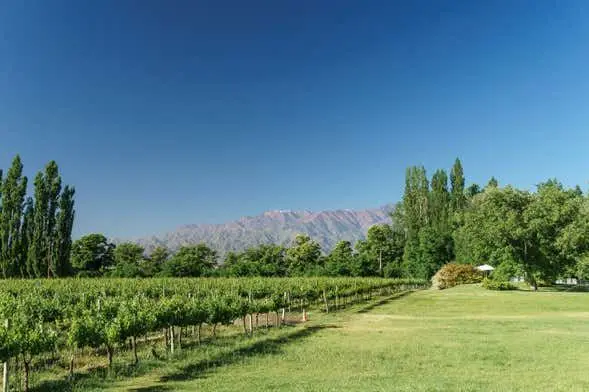
The Uco Valley takes in Tupungato, Tunuyán and San Carlos, south of the city along RN 40: Tunuyán is about 80 km away. This is high-altitude vineyard country, between 900 and 1,700 metres, with modern winery architecture and the Andes as a backdrop. Because of the distances, tours usually focus on one sector. In the north, Tupungato has Gualtallary, with wineries such as Andeluna, Rutini or Domaine Bousquet. In the centre, Tunuyán adds Los Chacayes, a Geographical Indication since 2017, and Vista Flores, home to Salentein and La Vigilia. In the south, San Carlos has Paraje Altamira, La Consulta and El Cepillo, with Zuccardi Valle de Uco, Alfa Crux and Finca La Celia.
The Bus Vitivinícola covers the valley on Sundays (Andeluna, lunch and Salentein) and heads south on Wednesdays (Zuccardi or La Celia, Alfa Crux and lunch at Cundo). Group and private tours are also available.
The honest part: it's a ten-hour day with lots of driving and only two or three wineries, and tasting-menu lunches aren't cheap. If you have time, spending a night or two in the valley transforms the experience.
What to expect
- About an hour and a half on the road each way from the city
- Two or three wineries in one sector: north, centre or south of the valley
- Tastings of high-altitude wines, from Malbec to Chardonnay and Pinot Noir
- A long multi-course lunch with Andes views
- Back in the city between 5:30 and 7 pm, depending on the route
- Duration
- Full day (about 10 hours including transfers)
- Season
- Year-round. Harvest runs from late February to early April; autumn colours and snow-capped peaks in winter add to the views.
- Difficulty
- Easy: short walks, though it's a long day with many hours seated
- Who it suits
- Visitors who know the wine basics and want scenery and signature wineries, or anyone planning a second winery day.
- Departure
- From Mendoza city and Chacras de Coria, early in the morning, by transfer, tour or Bus Vitivinícola; some services add stops in Tupungato and Tunuyán.
- Reference price
- Bus Vitivinícola (transport only, 2026 rate): AR$68,800 per person on the Valle de Uco and Valle de Uco Sur routes; AR$52,800 on El Cepillo. Visits and lunch extra.
How to book
Through a licensed agency or transfer, on the Bus Vitivinícola, or winery by winery if you stay in the valley. Confirm lunch, included visits and return time.
Tips
- One sector per day: pairing Gualtallary with Paraje Altamira means more road than wine.
- Book lunch first: there aren't many alternatives near the wineries.
- Stay over if you can: the national tourism board suggests two to five days in the valley.
- Look for Gualtallary, Los Chacayes or Paraje Altamira on labels so you can keep tasting the area at home.
What to bring: A warm layer: it cools quickly at altitude, even in summer · Sunscreen and sunglasses · Water and a snack for the road · Cash and a card
Tours to do it
Private Uco Valley Winery Tour from Mendoza
Uco Valley wineries with a private Spanish-speaking guide, tasting and lunch, from Mendoza.
See tour →
Domaine Bousquet Visit: Vineyards and Tasting in Tupungato
Organic wines, high-altitude vineyards and a tasting of five wines in Uco Valley.
See tour →
Huarpe Riglos Winery Visit and Tasting in Agrelo
Vineyards, a Mendoza wine tasting, and an original piece of the Berlin Wall in Agrelo.
See tour →
Hinojosa Winery Visit in Tunuyán, Uco Valley
Family history since 1940, tasting and a guided tour of about an hour and a half.
See tour →
Sunset and Dinner at Andeluna Winery, Uco Valley
A full day from Mendoza: sunset between vineyards and mountains, with dinner and wines.
See tour →Places it covers
Bodega Andeluna
See details →Bodega Rutini
See details →Domaine Bousquet
See details →Bodegas Salentein
See details →Bodega La Vigilia
See details →Finca La Celia
See details →Also: Zuccardi Valle de Uco (Piedra Infinita) · Alfa Crux · Cundo · Gualtallary · Los Chacayes · Paraje Altamira
Frequently asked questions
Can I do the Uco Valley as a day trip from Mendoza?
Yes, that's the most common way, but it's about 10 hours for two or three stops. If you can, spend at least one night in the valley.
What's the difference between the north and south of the valley?
Tupungato (Gualtallary) and Tunuyán (Los Chacayes, Vista Flores) are closer; San Carlos (Paraje Altamira, El Cepillo) means more driving. Pick one sector per day.
What are Gualtallary, Los Chacayes and Paraje Altamira?
High-altitude vineyard areas whose names appear on labels. Los Chacayes has been a Geographical Indication since 2017, and Paraje Altamira is also a GI.
Is there public transport to the valley's wineries?
Not in any practical way. Most people go on a tour, private transfer, the Bus Vitivinícola (Sundays and Wednesdays) or by car with a non-drinking driver.
Seasons, prices and roads change: confirm with the operator when booking. Sources
More activities

Winery tour in Luján de Cuyo
Malbec country half an hour from the city: big-name and boutique wineries in Agrelo, Perdriel, Vistalba and Chacras de Coria.
See activity →
Winery tour in Maipú
The wine district closest to the city: century-old wineries, wine museums and olive mills where you can taste local olive oil.
See activity →
Maipú wineries by bike
Rent a bike and build your own route between Maipú's wineries, olive mills and vineyards, at your own pace and without a transfer.
See activity →